
Who holds the most cash? Reliance.
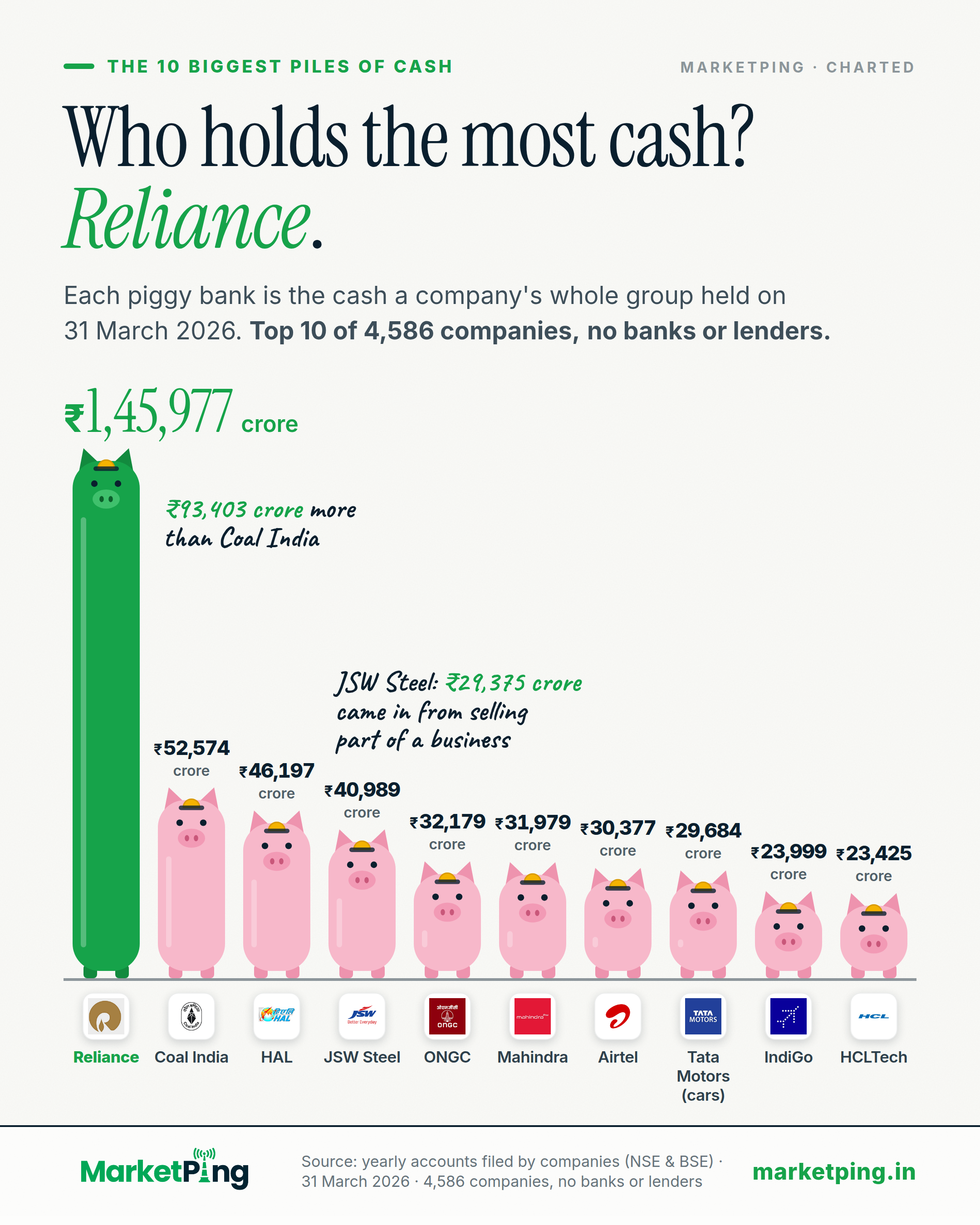
Each piggy bank is the cash a company's whole group held on 31 March 2026. Top 10 of 4,586 companies, no banks or lenders.
What the chart shows
On 31 March 2026, Reliance's group held ₹1,45,977 crore (₹1.46 lakh crore) in cash and bank balances: the most of the 4,586 listed companies we counted, banks and lenders left out, and ₹93,403 crore more than Coal India.
The 10 biggest piles of cash (31 March 2026, whole group)
| 1. Reliance | ₹1,45,977 crore |
|---|---|
| 2. Coal India | ₹52,574 crore |
| 3. HAL | ₹46,197 crore |
| 4. JSW Steel | ₹40,989 crore |
| 5. ONGC | ₹32,179 crore |
| 6. Mahindra | ₹31,979 crore |
| 7. Airtel | ₹30,377 crore |
| 8. Tata Motors (cars) | ₹29,684 crore |
| 9. IndiGo | ₹23,999 crore |
| 10. HCLTech | ₹23,425 crore |
Next: Infosys, ₹22,201 crore. 3 of the ten are government companies. In the year, JSW Steel received ₹29,375 crore from selling part of a business. Mahindra's figure includes ₹7,568 crore held by Mahindra Finance, a lender it owns; without it, Mahindra would still be in the ten.
What this is: the cash and bank balances in each company's yearly accounts on the last day of its year, including fixed deposits of up to a year. For a company that owns others, it is the whole group's. What it is not: profit, or money in funds and bonds, or a sign that a company is good or bad. A big pile can be waiting for spending already planned or money already owed. Banks, lenders and insurers are left out, because for them cash is the business itself.
How it is measured
The figure is the cash and bank balances each company held on 31 March 2026, from its yearly accounts (balance sheet): notes and coins, money in bank accounts and deposits that mature within three months (cash and cash equivalents), plus other money in banks, mostly fixed deposits of up to a year (other bank balances). Both lines are counted because which one a deposit lands in depends only on how long it runs. Bank balances can include money held for a set purpose, such as unpaid dividends or deposits pledged as security; the accounts do not split this out.
Money put in funds, bonds and other short-term investments is not counted. For a company that owns others, the figure is the whole group's (consolidated), which includes every company it owns more than half of, including companies abroad and any lending arm. A company without group accounts is counted on its own (standalone).
Where a year has more than one version on file, the latest is used. Banks, lenders and insurers are left out (724 companies), because for them cash is the business itself: a bank's cash is mostly its customers' money. 4,586 other listed companies show a cash figure for 31 March 2026. As a check against reading errors, a company is ranked only when its figure is no bigger than everything it owned and, where it reported one a year earlier, between a third and 3 times that figure, unless its own cash flow statement shows the change (JSW Steel: its cash and cash equivalents went from ₹11,655 crore to ₹39,256 crore, ₹27,601 crore added in the year); 4,304 are ranked and 282 are set aside, none of them with a figure as big as the 10th here.
Of the 21 companies with no figure for 31 March 2026, 17 can be shown to sit below the ten from their latest balance sheet; 4 cannot be checked: Enkei Wheels (India), John Cockerill India, Kennametal India, Elantas Beck India. Mahindra's figure includes ₹7,568 crore held by Mahindra Finance, a lender it owns; without it, Mahindra would still be in the ten. Reliance is first on every reading we tried: on its own company alone (₹1,08,179 crore), on cash and cash equivalents alone, and with short-term investments added.
No total of the ten is given: a group's figure includes the companies it owns, so a total could count the same money twice. A pile of cash is not profit, and it says nothing about whether a company is good, cheap or well run. A big pile can be waiting for spending already planned or money already owed.
Using this chart
Free to quote and republish. This chart, with its text, is licensed under Creative Commons Attribution 4.0, including for commercial use and news reporting.
- Reprint the chart, or redraw it in your own style
- Quote its finding and figures
- Use it in print, online, on screen or on air
- Credit MarketPing
- Link to this page where your format allows
- Give the data date: 7 October 2026
The licence covers this page only, not the rest of MarketPing or its data. See our Terms, section 9A.
How to cite
- News storyIn print or online copy
Source: MarketPing, data as of 7 Oct 2026 (marketping.in/charts/cash-pile) - Chart or broadcastUnder the chart, on screen or on air
Source: MarketPing (marketping.in) - Research paperAPA style
MarketPing. (2026, October 6). Who holds the most cash? Reliance. [Chart]. https://marketping.in/charts/cash-pile
Keep the date: this chart is rebuilt every day and may read differently tomorrow.
More on more charts


Facts from public exchange data and company filings. Not investment advice, and not a recommendation about any security. For frozen, citable findings with a full method, see our studies.