
Who pays lenders most? Transport, paper and power.
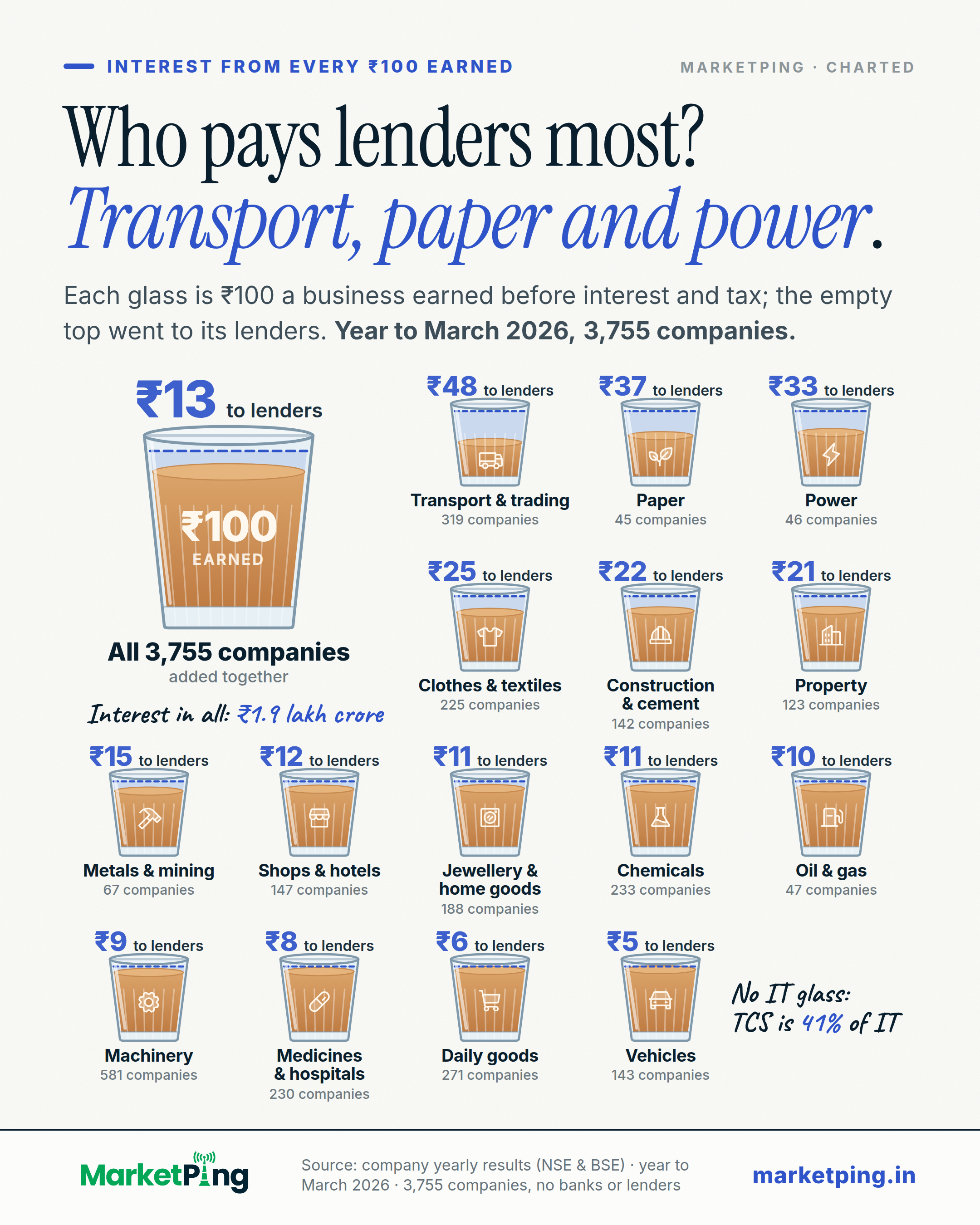
Each glass is ₹100 a business earned before interest and tax; the empty top went to its lenders. Year to March 2026, 3,755 companies.
What the chart shows
In the year to March 2026, transport and trading companies paid ₹48 of every ₹100 they earned to their lenders as interest, paper companies ₹37 and power companies ₹33, the most of any industry. Vehicle companies paid the least, ₹5. All 3,755 companies added together: ₹13.
Interest from every ₹100 earned, by industry
| Transport & trading | ₹48 (319 companies) |
|---|---|
| Paper | ₹37 (45 companies) |
| Power | ₹33 (46 companies) |
| Clothes & textiles | ₹25 (225 companies) |
| Construction & cement | ₹22 (142 companies) |
| Property | ₹21 (123 companies) |
| Metals & mining | ₹15 (67 companies) |
| Shops & hotels | ₹12 (147 companies) |
| Jewellery & home goods | ₹11 (188 companies) |
| Chemicals | ₹11 (233 companies) |
| Oil & gas | ₹10 (47 companies) |
| Machinery | ₹9 (581 companies) |
| Medicines & hospitals | ₹8 (230 companies) |
| Daily goods | ₹6 (271 companies) |
| Vehicles | ₹5 (143 companies) |
Also counted, not drawn: Media ₹17 (56 companies). No glass: IT services ₹3 (179 companies; TCS is 41% of its earnings), Telecom ₹36 (19 companies; Airtel is 66% of its earnings), Mixed businesses ₹32 (13 companies). Too few companies, or one company too big to add up fairly. Is it just one big company? No: leave out Adani Ports and transport and trading companies still paid ₹42 (₹35 without IndiGo, the biggest interest payer); leave out JK Paper and paper companies still paid ₹37 (₹33 without Tamil Nadu Newsprint, the biggest interest payer); leave out NTPC and power companies still paid ₹33. Transport & trading: ports, airlines, airports, shipping, delivery and other transport firms (81 of its 319 companies) paid 85% of its interest; on their own they paid ₹59 of every ₹100, the traders and other firms in the group ₹24.
Left out: banks and lenders; 728 companies that made a loss even before interest; and 156 whose earnings were mostly a one-off gain or cost, such as selling a business. With the one-off companies put back, the all-company figure is ₹14; with the loss-makers put back too, ₹15.
What this is: the interest charged in each company's yearly accounts (on loans and bonds, and on long leases such as planes and offices), divided by what it earned before interest and tax. All the companies in an industry are added together, so big companies weigh more. What it is not: how much a company owes. And a big share is not good or bad by itself: power plants, ports, planes and homes are built and bought with borrowed money, so those businesses pay more interest.
How it is measured
How much of every ₹100 a business earned before interest and tax went to its lenders (banks and others who lent it money), industry by industry, for the year to March 2026, from each company's own yearly accounts: the company alone, not its group (standalone), so a listed company owned by another listed company is not counted twice. Interest is the interest charged in the year's accounts (finance costs): on loans and bonds, and also on long leases such as planes, offices and port land, which the accounts treat like a loan. Earnings before interest and tax are profit before tax with that interest added back.
A group's figure is all its companies' interest added together divided by all their earnings before interest and tax added together, so big companies weigh more than small ones. 3,755 companies count. Left out: 723 banks, lenders, insurers and other financial companies, for whom interest is the main cost of doing business; 728 companies that made a loss even before interest (a share of a loss means nothing; together they lost ₹20,309 crore before interest and still paid ₹12,301 crore of it); 20 with no profit figure; 1 with interest below zero, a filing error; and 156 whose earnings were mostly a one-off gain or cost, such as selling a business or a one-time charge (one-off items, called exceptional items, more than half of earnings before interest; the biggest: Vodafone Idea, ₹58,684 crore one-off gain; Meesho, ₹26,377 crore one-off gain). With those one-off companies put back, all companies together paid ₹14.0; with the loss-makers put back as well, ₹15.0. 231 companies that count reported no interest at all; they are kept in, because a company with no loans pays none (without them: ₹13.4). 117 companies paid more interest than they earned and are kept in.
All companies together: ₹13.4; ₹13.9 without the biggest earner (TCS), ₹12.6 without the biggest interest payer (Airtel). Industry is the industry group on file for each company, in plain words; Power includes water and waste companies, Construction & cement joins builders and cement makers, Jewellery & home goods is jewellery, paint, appliances and other things for the home. Transport & trading: ports, airlines, airports, shipping, delivery and other transport firms (81 of its 319 companies) paid 85% of its interest; on their own they paid ₹59 of every ₹100, the traders and other firms in the group ₹24. 681 of the 3,755 companies have no industry on file and are in no industry glass; they are in the all-company glass.
An industry gets a glass only with at least 40 companies and no one company above 40% of its earnings, else the glass would be one company's result. Left out on that rule: IT services ₹3 (179 companies; TCS is 41% of its earnings), Telecom ₹36 (19 companies; Airtel is 66% of its earnings), Mixed businesses ₹32 (13 companies). The top 3 industries are named in the headline only because each stays above every other industry even with its biggest company, or its biggest interest payer, left out (Transport & trading ₹48: ₹42 without Adani Ports, ₹35 without IndiGo; Paper ₹37: ₹37 without JK Paper, ₹33 without Tamil Nadu Newsprint; Power ₹33: ₹33 without NTPC); with a one-off limit twice as strict, the same 3 industries stay on top.
Builders of homes and power plants often add the interest on a project's loans to the cost of the project while it is being built, so that interest is not in the year's figure. Each layer is drawn from the exact figure; the printed rupees are rounded to whole rupees. This is arithmetic on filed accounts, not a view on any company or industry.
How this chart has read
The finding in one sentence, on each day its numbers changed.
- In the year to March 2026, transport and trading companies paid ₹48 of every ₹100 they earned to their lenders as interest, paper companies ₹37 and power companies ₹33, the most of any industry. Vehicle companies paid the least, ₹5. All 3,755 companies added together: ₹13.
- In the year to March 2026, transport and trading companies paid ₹48 of every ₹100 they earned to their lenders as interest, paper companies ₹37 and power companies ₹33, the most of any industry. Vehicle companies paid the least, ₹5. All 3,728 companies added together: ₹13.
- In the year to March 2026, transport and trading companies paid ₹48 of every ₹100 they earned to their lenders as interest, paper companies ₹37 and power companies ₹33, the most of any industry. Vehicle companies paid the least, ₹5. All 3,727 companies added together: ₹13.
Using this chart
Free to quote and republish. This chart, with its text, is licensed under Creative Commons Attribution 4.0, including for commercial use and news reporting.
- Reprint the chart, or redraw it in your own style
- Quote its finding and figures
- Use it in print, online, on screen or on air
- Credit MarketPing
- Link to this page where your format allows
- Give the data date: 22 November 2026
The licence covers this page only, not the rest of MarketPing or its data. See our Terms, section 9A.
How to cite
- News storyIn print or online copy
Source: MarketPing, data as of 22 Nov 2026 (marketping.in/charts/interest-bite) - Chart or broadcastUnder the chart, on screen or on air
Source: MarketPing (marketping.in) - Research paperAPA style
MarketPing. (2026, November 21). Who pays lenders most? Transport, paper and power. [Chart]. https://marketping.in/charts/interest-bite
Keep the date: this chart is rebuilt every day and may read differently tomorrow.
More on more charts
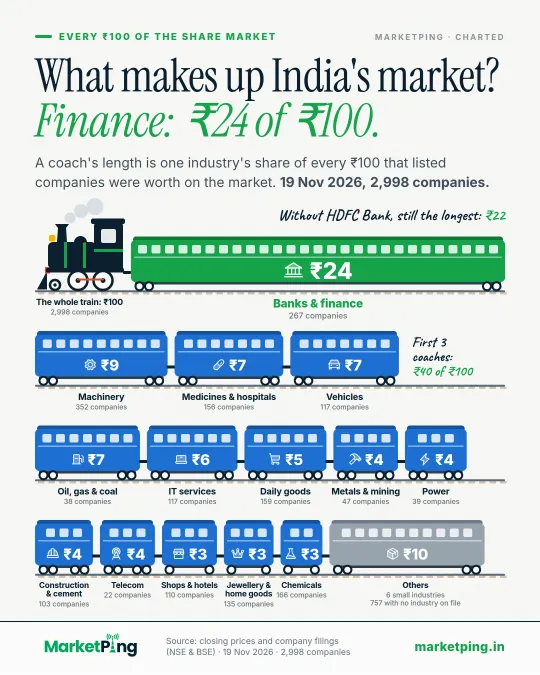 What makes up India's market? Finance: ₹24 of ₹100.
 Companies' loan ratings: up or down? Mostly up.
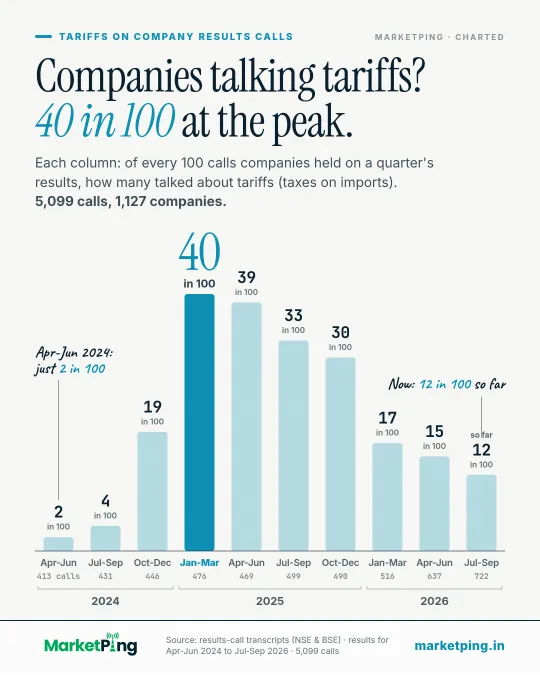 Companies talking tariffs? 40 in 100 at the peak.
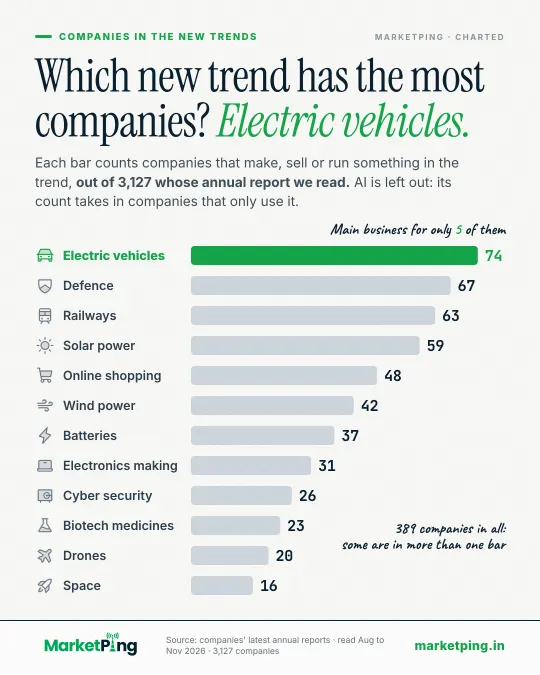 Which new trend has the most companies? Electric vehicles.
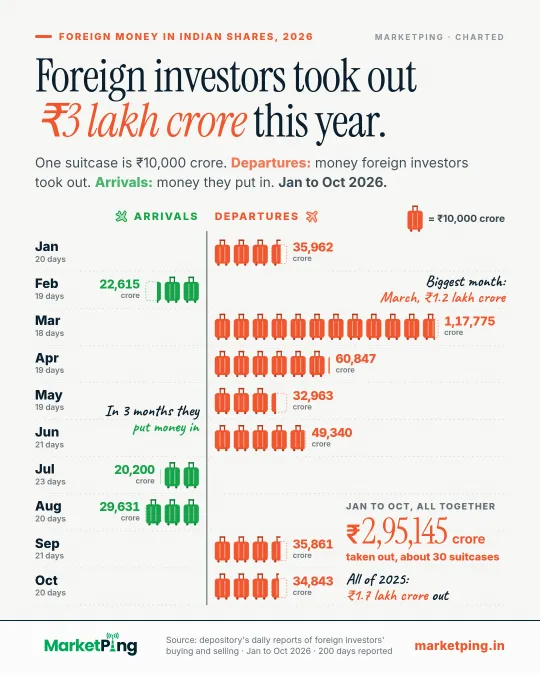 Foreign investors took out ₹3 lakh crore this year.
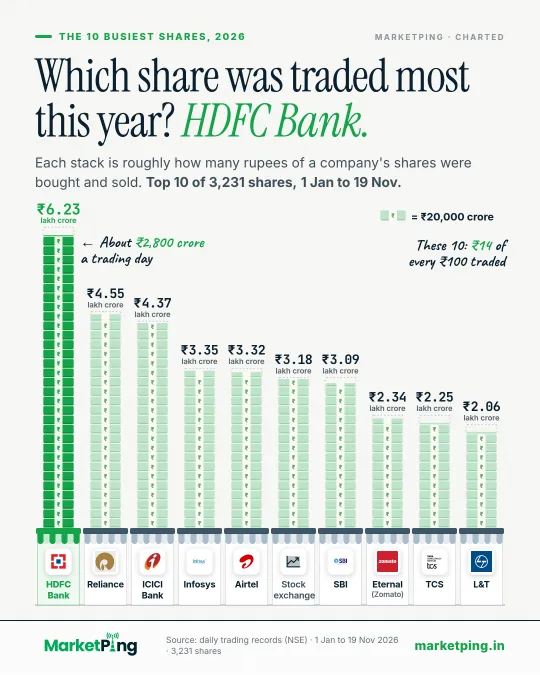 Which share was traded most this year? HDFC Bank.
Facts from public exchange data and company filings. Not investment advice, and not a recommendation about any security. For frozen, citable findings with a full method, see our studies.