
Who owns India's listed companies? Owner groups, half.
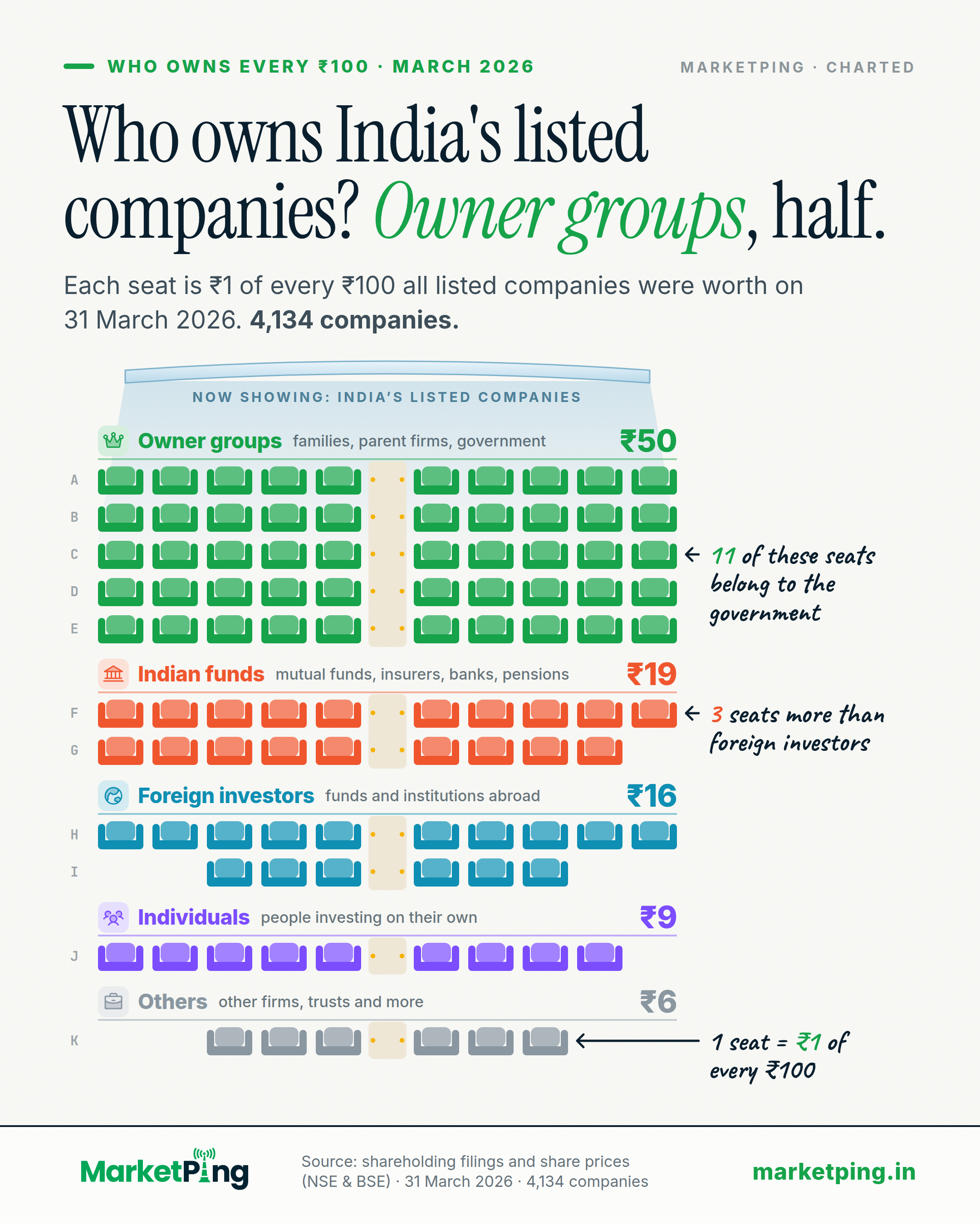
Each seat is ₹1 of every ₹100 all listed companies were worth on 31 March 2026. 4,134 companies.
What the chart shows
Of every ₹100 that India's listed companies were worth on 31 March 2026, ₹50 belonged to their owner groups: the families, parent companies and the government that control them (4,134 companies).
Who owns every ₹100
| ₹50 Owner groups | the families, parent companies and the government that control the companies (₹11 of it is the government, in the companies it runs). |
|---|---|
| ₹19 Indian funds | mutual funds, insurers, banks and pension funds, investing other people's money. |
| ₹16 Foreign investors | funds and institutions based abroad. |
| ₹9 Individuals | people in India who hold shares in their own name. |
| ₹6 Others | other companies, trusts, Indians living abroad, shares traded abroad as receipts, and government stakes in companies it does not run. |
Against March 2023, the first March the filings split foreign from Indian funds: for the same 2,634 companies (the ones we can value on both dates), Indian funds went from ₹16 to ₹19 of every ₹100, and foreign investors from ₹17 to ₹16. Foreign investors held more then; Indian funds hold more now.
What this is: who owned the shares, from each company's own shareholding filing, with each company counted by what it was worth that day. What it is not: who trades the most, and not advice.
How it is measured
Ownership is each company's own shareholding filing for the quarter to 31 March 2026 (4,581 companies filed). Each company counts by what it was worth that day: its number of shares times its last share price on or before 31 March 2026. Of every ₹100 all 4,134 companies were worth together (₹385.1 lakh crore), the owner groups held ₹50.1, Indian funds ₹18.7, foreign investors ₹16.0, individuals ₹9.0 and others ₹6.2.
The hall has exactly 100 seats: each group's rupees are rounded to whole seats so that the seats add up to 100 (the largest-remainder method: round everything down, then give the leftover seats to the biggest remainders). Owner groups are what the filings call promoters: the families, parent companies and, for government-run companies, the government. ₹10.6 of the owner groups' share sits in government-run companies. Indian funds are mutual funds, insurers, banks, pension and provident funds; foreign investors are funds and institutions based abroad; individuals are people in India holding shares in their own name.
Others are other companies (₹1.6), shares traded abroad as receipts (₹0.7), the government where it holds shares in a company it does not run (₹0.6), employee trusts (₹0.1), and trusts, Indians living abroad and the like. Left out: 292 companies with no share price in the month before 31 March 2026 (most had not traded for a year; the 56 that had were worth about ₹1,185 crore together), 152 companies whose filings mention bonus shares or share splits that may have put the price history we hold out of step with their March share count, and 3 filings that did not add up or were not ordinary shares. 10 companies that handed out bonus shares after 31 March 2026 are counted at their price before the bonus, worked out from the bonus ratio in their own filing. The order of the five groups is the same without the biggest company and with shares traded abroad as receipts counted as foreign.
This is who owned the shares, not who trades the most, and it is not advice.
How this chart has read
The finding in one sentence, on each day its numbers changed.
- Of every ₹100 that India's listed companies were worth on 31 March 2026, ₹50 belonged to their owner groups: the families, parent companies and the government that control them (4,134 companies).
- Of every ₹100 that India's listed companies were worth on 31 March 2026, ₹50 belonged to their owner groups: the families, parent companies and the government that control them (4,135 companies).
- Of every ₹100 that India's listed companies were worth on 31 March 2026, ₹50 belonged to their owner groups: the families, parent companies and the government that control them (4,137 companies).
- Of every ₹100 that India's listed companies were worth on 31 March 2026, ₹50 belonged to their owner groups: the families, parent companies and the government that control them (4,138 companies).
- Of every ₹100 that India's listed companies were worth on 31 March 2026, ₹50 belonged to their owner groups: the families, parent companies and the government that control them (4,140 companies).
- Of every ₹100 that India's listed companies were worth on 31 March 2026, ₹50 belonged to their owner groups: the families, parent companies and the government that control them (4,142 companies).
- Of every ₹100 that India's listed companies were worth on 31 March 2026, ₹50 belonged to their owner groups: the families, parent companies and the government that control them (4,145 companies).
- Of every ₹100 that India's listed companies were worth on 31 March 2026, ₹50 belonged to their owner groups: the families, parent companies and the government that control them (4,146 companies).
- Of every ₹100 that India's listed companies were worth on 31 March 2026, ₹50 belonged to their owner groups: the families, parent companies and the government that control them (4,147 companies).
- Of every ₹100 that India's listed companies were worth on 31 March 2026, ₹50 belonged to their owner groups: the families, parent companies and the government that control them (4,152 companies).
- Of every ₹100 that India's listed companies were worth on 31 March 2026, ₹50 belonged to their owner groups: the families, parent companies and the government that control them (4,153 companies).
- Of every ₹100 that India's listed companies were worth on 31 March 2026, ₹50 belonged to their owner groups: the families, parent companies and the government that control them (4,169 companies).
- Of every ₹100 that India's listed companies were worth on 31 March 2026, ₹50 belonged to their owner groups: the families, parent companies and the government that control them (4,170 companies).
- Of every ₹100 that India's listed companies were worth on 31 March 2026, ₹50 belonged to their owner groups: the families, parent companies and the government that control them (4,172 companies).
- Of every ₹100 that India's listed companies were worth on 31 March 2026, ₹50 belonged to their owner groups: the families, parent companies and the government that control them (4,180 companies).
- Of every ₹100 that India's listed companies were worth on 31 March 2026, ₹50 belonged to their owner groups: the families, parent companies and the government that control them (4,184 companies).
- Of every ₹100 that India's listed companies were worth on 31 March 2026, ₹50 belonged to their owner groups: the families, parent companies and the government that control them (4,188 companies).
- Of every ₹100 that India's listed companies were worth on 31 March 2026, ₹50 belonged to their owner groups: the families, parent companies and the government that control them (4,194 companies).
- Of every ₹100 that India's listed companies were worth on 31 March 2026, ₹50 belonged to their owner groups: the families, parent companies and the government that control them (4,196 companies).
- Of every ₹100 that India's listed companies were worth on 31 March 2026, ₹50 belonged to their owner groups: the families, parent companies and the government that control them (4,197 companies).
- Of every ₹100 that India's listed companies were worth on 31 March 2026, ₹50 belonged to their owner groups: the families, parent companies and the government that control them (4,198 companies).
- Of every ₹100 that India's listed companies were worth on 31 March 2026, ₹50 belonged to their owner groups: the families, parent companies and the government that control them (4,199 companies).
- Of every ₹100 that India's listed companies were worth on 31 March 2026, ₹50 belonged to their owner groups: the families, parent companies and the government that control them (4,200 companies).
- Of every ₹100 that India's listed companies were worth on 31 March 2026, ₹50 belonged to their owner groups: the families, parent companies and the government that control them (4,201 companies).
- Of every ₹100 that India's listed companies were worth on 31 March 2026, ₹50 belonged to their owner groups: the families, parent companies and the government that control them (4,205 companies).
- Of every ₹100 that India's listed companies were worth on 31 March 2026, ₹50 belonged to their owner groups: the families, parent companies and the government that control them (4,211 companies).
Using this chart
Free to quote and republish. This chart, with its text, is licensed under Creative Commons Attribution 4.0, including for commercial use and news reporting.
- Reprint the chart, or redraw it in your own style
- Quote its finding and figures
- Use it in print, online, on screen or on air
- Credit MarketPing
- Link to this page where your format allows
- Give the data date: 22 November 2026
The licence covers this page only, not the rest of MarketPing or its data. See our Terms, section 9A.
How to cite
- News storyIn print or online copy
Source: MarketPing, data as of 22 Nov 2026 (marketping.in/charts/owner-seats) - Chart or broadcastUnder the chart, on screen or on air
Source: MarketPing (marketping.in) - Research paperAPA style
MarketPing. (2026, November 21). Who owns India's listed companies? Owner groups, half. [Chart]. https://marketping.in/charts/owner-seats
Keep the date: this chart is rebuilt every day and may read differently tomorrow.
More on more charts
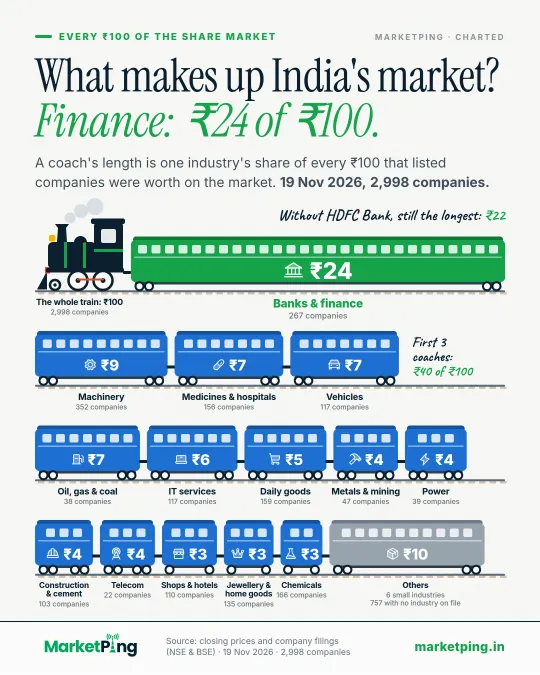 What makes up India's market? Finance: ₹24 of ₹100.
 Companies' loan ratings: up or down? Mostly up.
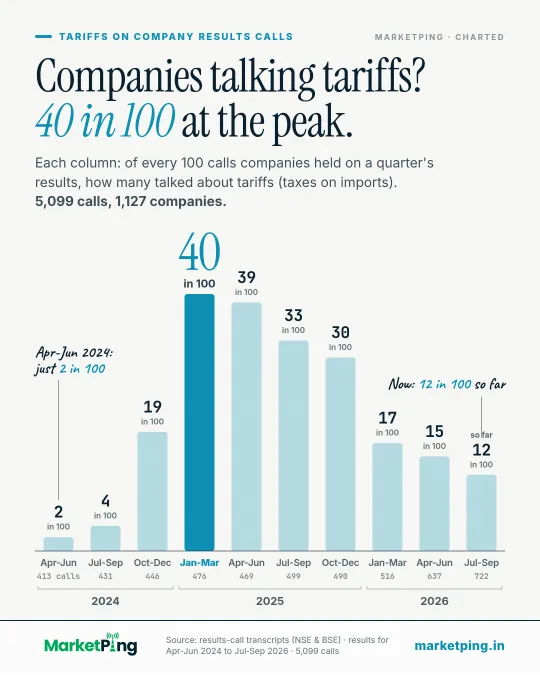 Companies talking tariffs? 40 in 100 at the peak.
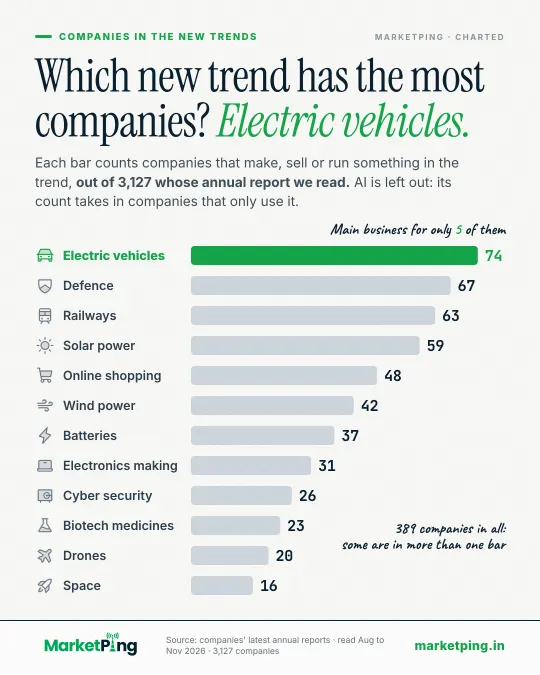 Which new trend has the most companies? Electric vehicles.
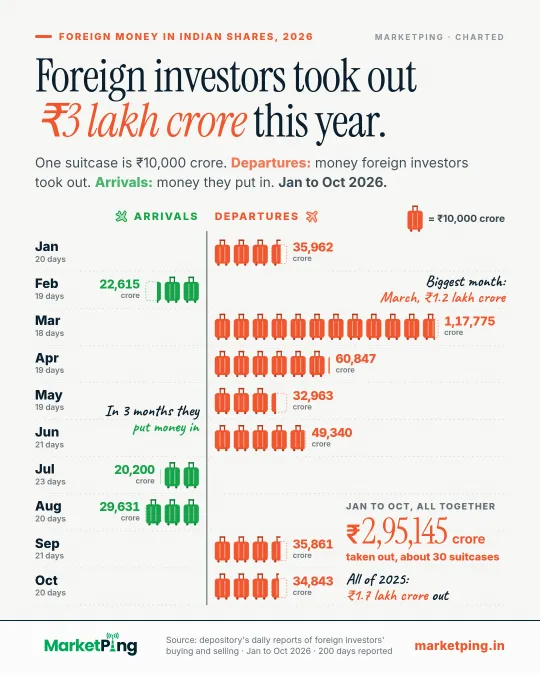 Foreign investors took out ₹3 lakh crore this year.
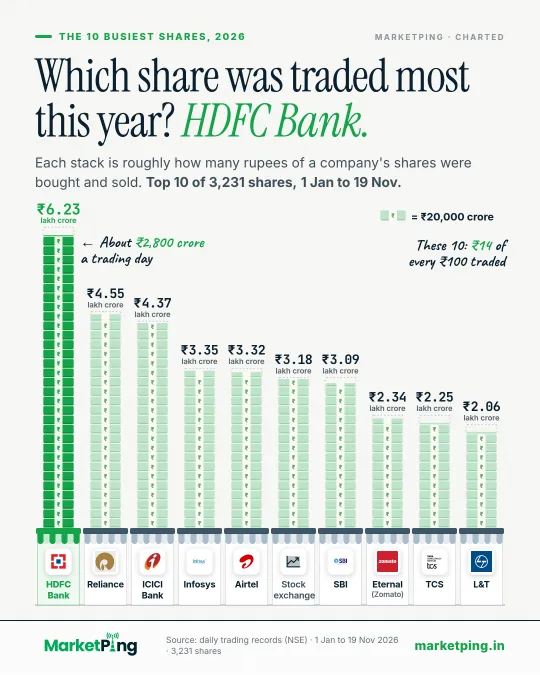 Which share was traded most this year? HDFC Bank.
Facts from public exchange data and company filings. Not investment advice, and not a recommendation about any security. For frozen, citable findings with a full method, see our studies.