
How many owners pawn their shares? 13 in 100.
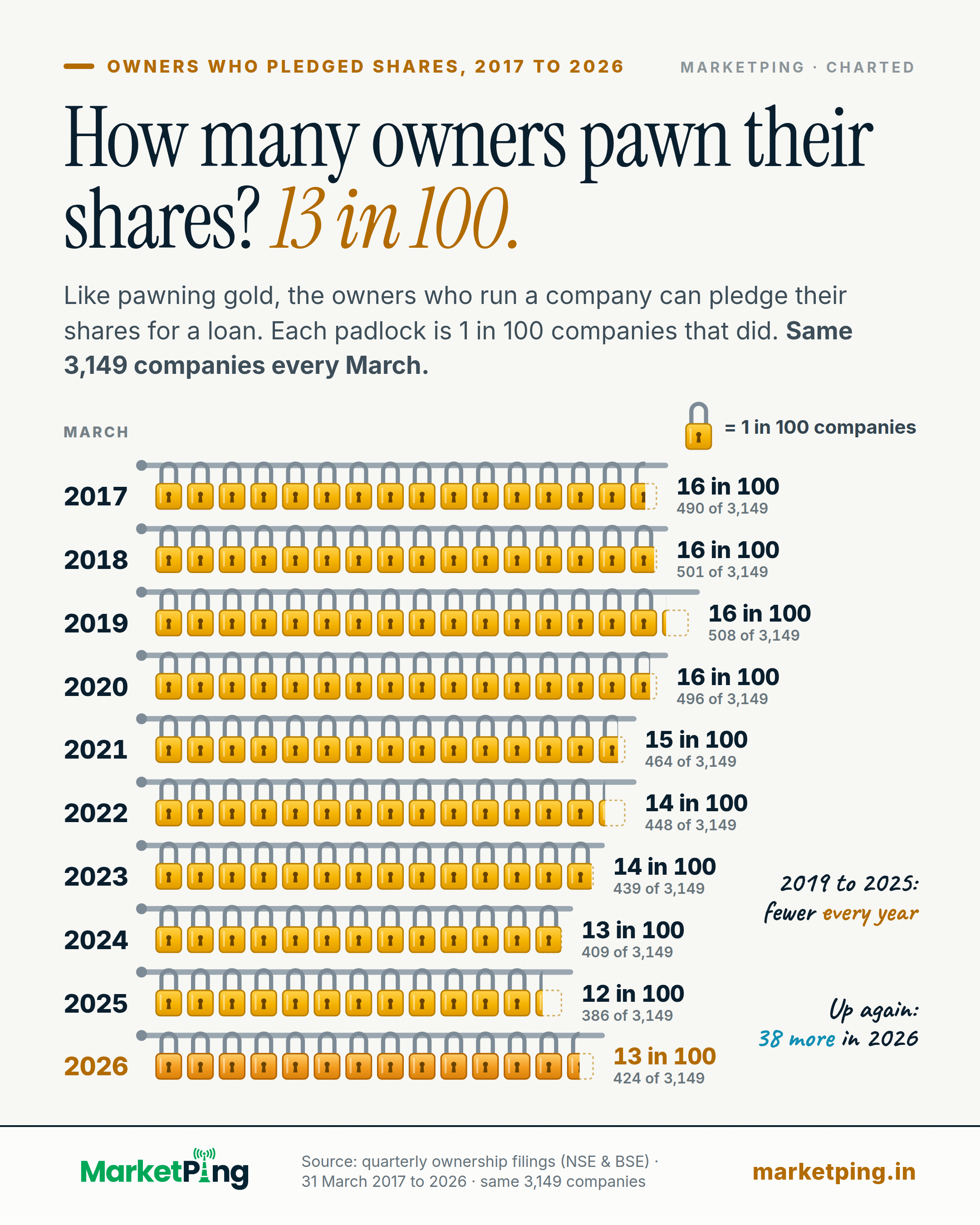
Like pawning gold, the owners who run a company can pledge their shares for a loan. Each padlock is 1 in 100 companies that did. Same 3,149 companies every March.
What the chart shows
On 31 March 2026, the owners of 424 of 3,149 companies (13 in 100) had pledged some of their shares for a loan. In 2019 it was 508 (16 in 100).
The same 3,149 companies, every 31 march
| 2017 | 490 of 3,149 (16 in 100) |
|---|---|
| 2018 | 501 of 3,149 (16 in 100) |
| 2019 | 508 of 3,149 (16 in 100) |
| 2020 | 496 of 3,149 (16 in 100) |
| 2021 | 464 of 3,149 (15 in 100) |
| 2022 | 448 of 3,149 (14 in 100) |
| 2023 | 439 of 3,149 (14 in 100) |
| 2024 | 409 of 3,149 (13 in 100) |
| 2025 | 386 of 3,149 (12 in 100) |
| 2026 | 424 of 3,149 (13 in 100) |
All companies with an owner group that year (we hold more companies each year)
| 2017 | 529 of 3,367 (16 in 100) |
|---|---|
| 2018 | 556 of 3,477 (16 in 100) |
| 2019 | 579 of 3,575 (16 in 100) |
| 2020 | 557 of 3,612 (15 in 100) |
| 2021 | 537 of 3,665 (15 in 100) |
| 2022 | 531 of 3,755 (14 in 100) |
| 2023 | 529 of 3,862 (14 in 100) |
| 2024 | 513 of 4,014 (13 in 100) |
| 2025 | 503 of 4,161 (12 in 100) |
| 2026 | 570 of 4,401 (13 in 100) |
In 2026, 50 of the 424 had pledged less than 1 in 100 of their shares. Counted by shares instead: of every 100 shares these owners held, about 11 were pledged in March 2017 and about 5 in March 2026.
Why owners pledge: to borrow money against shares they already own, without selling them. The shares stay theirs, but the lender holds them as security, like gold at a pawn shop. If the share price falls a lot, the pledged shares may no longer cover the loan. The lender can then ask for more shares or money, or sell the pledged shares to get its money back. What this is not: pledging is legal and common, and it is not a sign that a company is in trouble. This counts companies and names none. It is not advice.
How it is measured
Each row counts, on 31 March of each year, the companies whose owners (the promoter group: the family or group that runs the company) had pledged any of their shares, as listed in the company's quarterly ownership filing. To keep the comparison fair, every row is the same 3,149 companies: those with an owner group on 31 March of every year from 2017 to 2026. Any pledge counts, however small: in 2026, 50 of the 424 had pledged less than 1 in 100 of the owners' shares.
The filing's count covers shares pledged or otherwise promised to a lender (such as a promise not to sell them). From late 2025 the filing lists these separately: in 2026, 400 of the 424 were pledges and 24 were only such promises. One padlock stands for 1 in 100 of these companies; the last padlock in a row is cut to its exact share, and each row prints its exact count.
Pledging shares is legal and common, and it is not a sign that a company is in trouble. This counts companies and names none. It is not advice.
Using this chart
Free to quote and republish. This chart, with its text, is licensed under Creative Commons Attribution 4.0, including for commercial use and news reporting.
- Reprint the chart, or redraw it in your own style
- Quote its finding and figures
- Use it in print, online, on screen or on air
- Credit MarketPing
- Link to this page where your format allows
- Give the data date: 22 November 2026
The licence covers this page only, not the rest of MarketPing or its data. See our Terms, section 9A.
How to cite
- News storyIn print or online copy
Source: MarketPing, data as of 22 Nov 2026 (marketping.in/charts/pledge-count) - Chart or broadcastUnder the chart, on screen or on air
Source: MarketPing (marketping.in) - Research paperAPA style
MarketPing. (2026, November 21). How many owners pawn their shares? 13 in 100. [Chart]. https://marketping.in/charts/pledge-count
Keep the date: this chart is rebuilt every day and may read differently tomorrow.
More on more charts
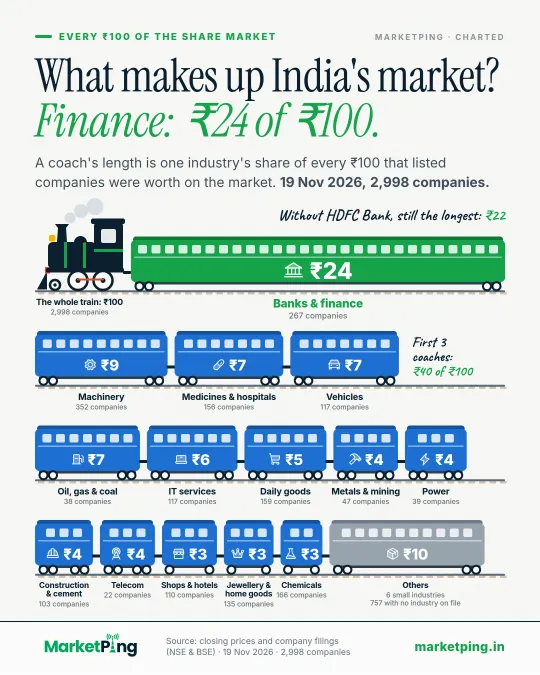 What makes up India's market? Finance: ₹24 of ₹100.
 Companies' loan ratings: up or down? Mostly up.
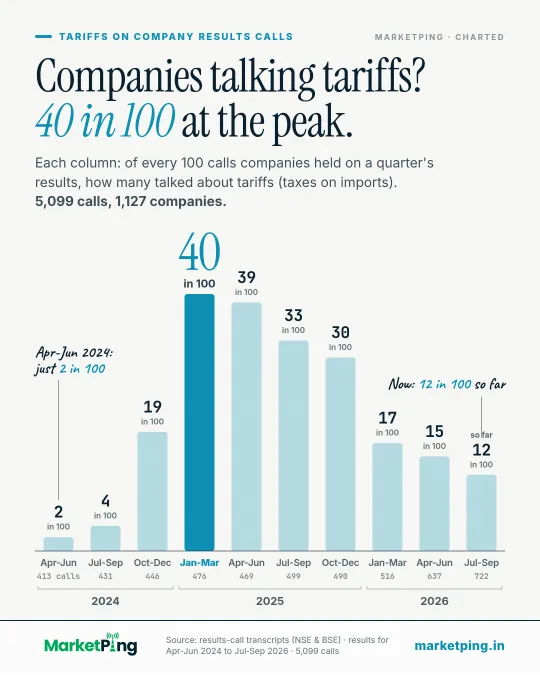 Companies talking tariffs? 40 in 100 at the peak.
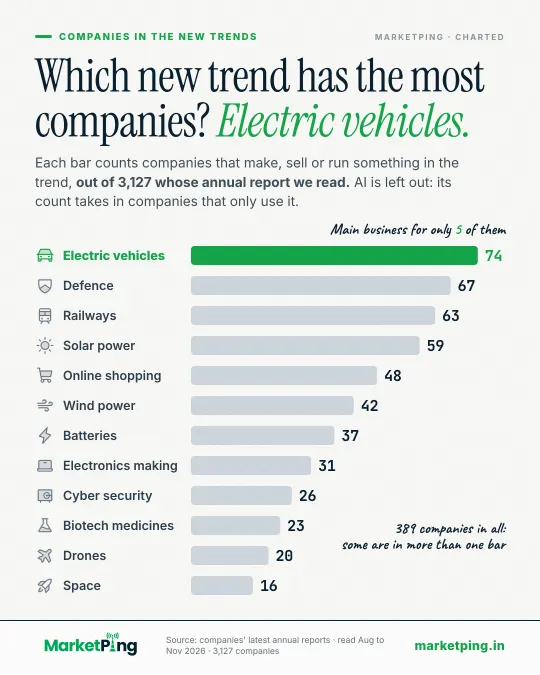 Which new trend has the most companies? Electric vehicles.
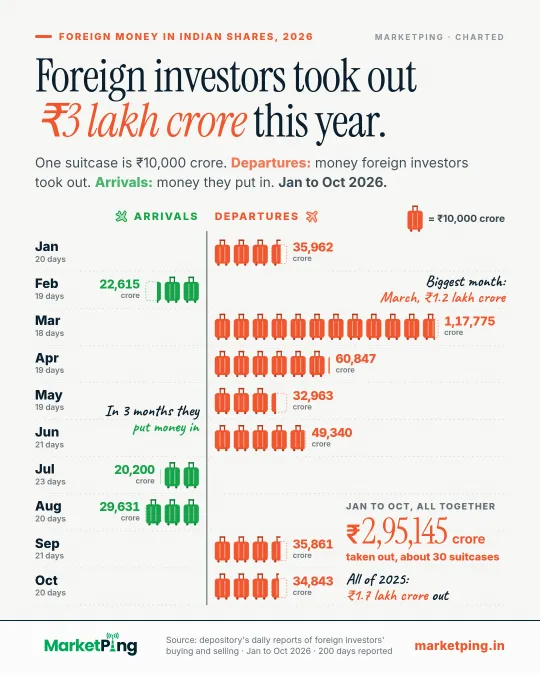 Foreign investors took out ₹3 lakh crore this year.
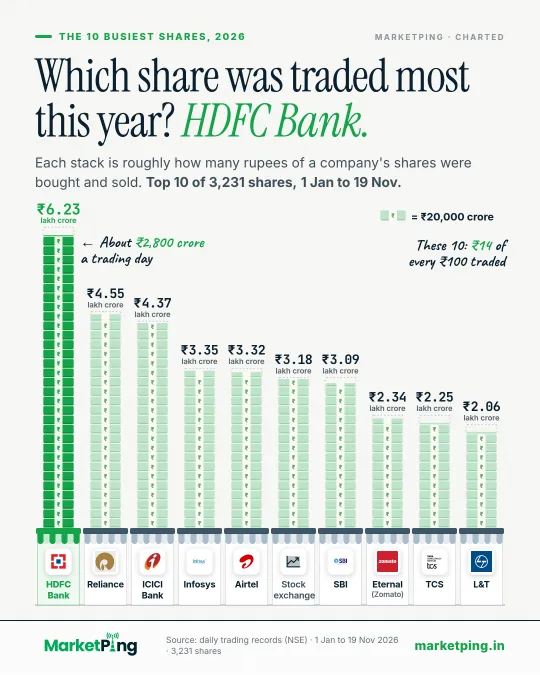 Which share was traded most this year? HDFC Bank.
Facts from public exchange data and company filings. Not investment advice, and not a recommendation about any security. For frozen, citable findings with a full method, see our studies.