
Who owns more now, foreign or Indian funds? Indian.
Each seat is one company, coloured by which side owns more of it. The same 47 of the 50 biggest companies (Nifty 50).
What the chart shows
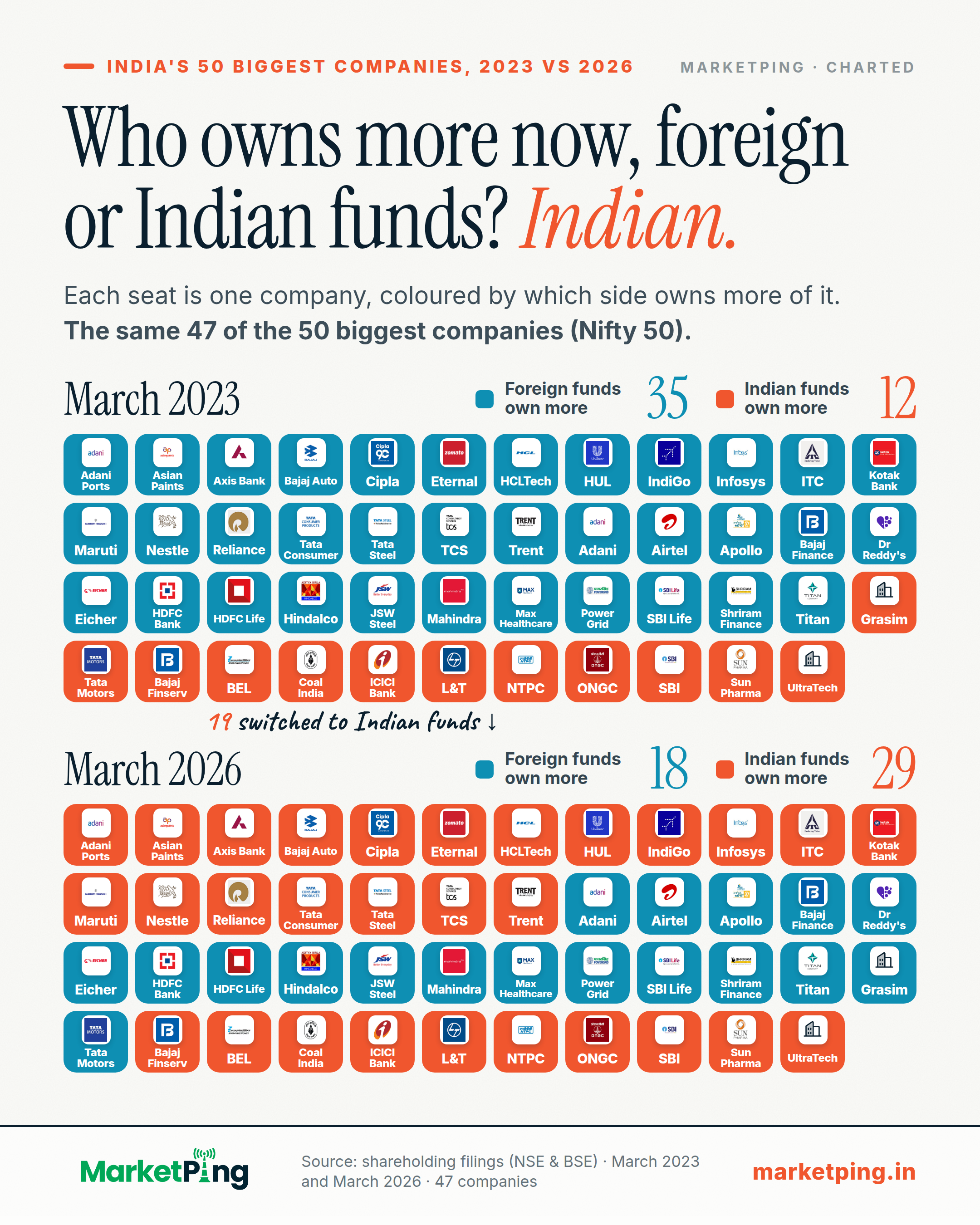
Who owns more of India's 50 biggest companies, foreign funds or Indian funds? In March 2023, foreign funds held more of the shares in 35 of 47 companies. By March 2026, Indian funds held more in 29.
FOREIGN FUNDS OWN MORE: 35 (March 2023) -> 18 (March 2026) INDIAN FUNDS OWN MORE: 12 -> 29
Switched to Indian funds (19): Adani Ports, Reliance, ITC, TCS, Hindustan Unilever, Maruti, Nestle, Bajaj Auto, Tata Consumer, IndiGo, Kotak Bank, HCLTech, Cipla, Infosys, Tata Steel, Asian Paints, Eternal (Zomato), Axis Bank and Trent. Switched to foreign funds (2): Grasim and Tata Motors.
On average, foreign funds held 25.4 of every 100 shares in March 2023 and 22.2 in March 2026. Indian funds went from 18.7 to 23.9.
The same 47 companies are counted on both dates (Tech Mahindra and Jio Financial and BSE are not on file for both).
Foreign funds are investment funds, pension funds and banks from abroad that buy Indian shares. Indian funds are Indian mutual funds, insurance companies such as LIC, banks and pension funds. Founders and parent companies, and people who buy shares themselves, are in neither group.
What this is: who held more of each company's shares on two dates, as the companies filed it (latest filing: 31 March 2026). What it is not: a forecast, or advice to buy or sell.
How it is measured
The companies are the current members of the Nifty 50, a list of 50 of India's biggest companies on the stock market. 47 of them are counted, the same 47 on both dates; Tech Mahindra and Jio Financial and BSE are left out because their shareholding is not on file for both dates. Every quarter a company files who owns its shares. That filing has two groups of big investors: foreign funds (foreign portfolio investors: investment funds, pension funds and banks from abroad) and Indian funds (Indian mutual funds, insurance companies such as LIC, banks, and pension and provident funds).
A company is coloured by the group that held more of its shares on that date: 31 March 2023 and 31 March 2026. The filings split big investors into these two groups only from September 2022, so March 2023 is the earliest March that can be compared. Founders and parent companies (promoters), the government as an owner, and people who buy shares themselves are in neither group.
Shares traded abroad as depositary receipts (in New York or London) are in neither group too; counting them as foreign would move Axis Bank and ICICI Bank to the foreign side in March 2026, and Indian funds would still own more in 27 of the 47. In 5 companies the two groups were less than 1 share in every 100 apart in March 2026. This is who held more shares on two dates, as the companies filed it.
It is not a forecast, and not advice to buy or sell.
How this chart has read
The finding in one sentence, on each day its numbers changed.
- Who owns more of India's 50 biggest companies, foreign funds or Indian funds? In March 2023, foreign funds held more of the shares in 35 of 47 companies. By March 2026, Indian funds held more in 29.
- Who owns more of India's 50 biggest companies, foreign funds or Indian funds? In March 2023, foreign funds held more of the shares in 36 of 48 companies. By March 2026, Indian funds held more in 29.
Using this chart
Free to quote and republish. This chart, with its text, is licensed under Creative Commons Attribution 4.0, including for commercial use and news reporting.
- Reprint the chart, or redraw it in your own style
- Quote its finding and figures
- Use it in print, online, on screen or on air
- Credit MarketPing
- Link to this page where your format allows
- Give the data date: 8 October 2026
The licence covers this page only, not the rest of MarketPing or its data. See our Terms, section 9A.
How to cite
- News storyIn print or online copy
Source: MarketPing, data as of 8 Oct 2026 (marketping.in/charts/fund-flip) - Chart or broadcastUnder the chart, on screen or on air
Source: MarketPing (marketping.in) - Research paperAPA style
MarketPing. (2026, October 7). Who owns more now, foreign or Indian funds? Indian. [Chart]. https://marketping.in/charts/fund-flip
Keep the date: this chart is rebuilt every day and may read differently tomorrow.
More on more charts


Facts from public exchange data and company filings. Not investment advice, and not a recommendation about any security. For frozen, citable findings with a full method, see our studies.