Who gets the money in small IPOs? The company.
Each bar splits every ₹100 paid for IPO shares by who got it. 113 IPOs, 23 Jul to 7 Oct 2026.
What the chart shows
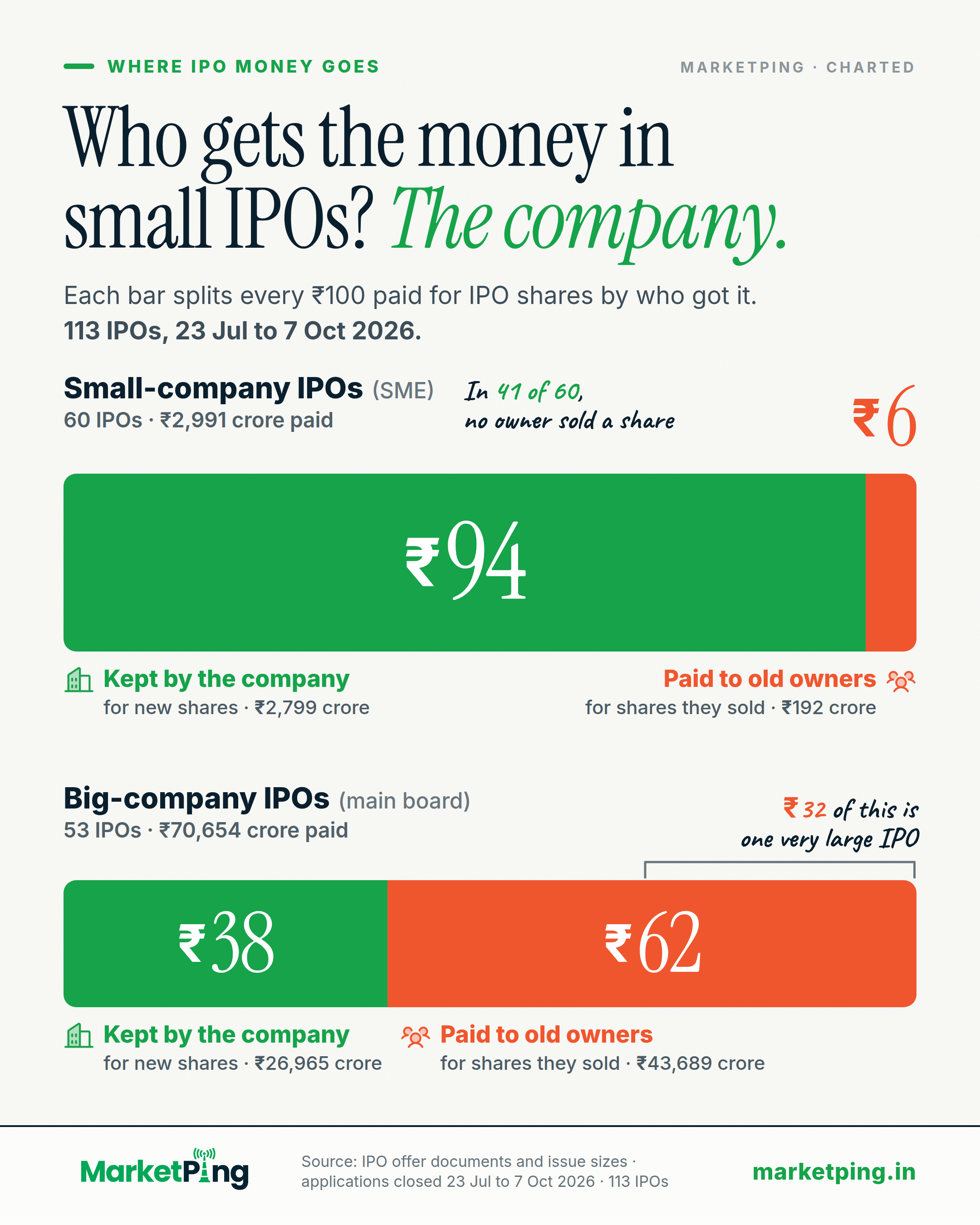
In the 60 small-company IPOs whose applications closed from 23 July to 7 October 2026, the companies kept ₹94 of every ₹100 people paid: ₹2,799 crore for new shares, against ₹192 crore to existing owners who sold. In 41 of the 60, no owner sold a single share.
SMALL-COMPANY (SME) IPOs: 60 Kept by the companies, for new shares: ₹2,799 crore (₹94 of every ₹100) Paid to existing owners, for shares they sold: ₹192 crore (₹6 of every ₹100)
BIG-COMPANY (MAIN-BOARD) IPOs: 53 Kept by the companies, for new shares: ₹26,965 crore (₹38 of every ₹100) Paid to existing owners, for shares they sold: ₹43,689 crore (₹62 of every ₹100) One IPO of ₹22,569 crore, in which every share was sold by existing owners, is ₹32 of that ₹100. Without it, the split is ₹56 to the companies and ₹44 to existing owners. In the typical big-company IPO, ₹29 of every ₹100 went to existing owners. 8 of the 53 sold only new shares; 3 sold only existing owners' shares.
What this is: when a company comes to the stock market, it can make new shares and sell them (that money goes to the company, for its plans), and its existing owners, like the founding family, early investors or funds, can sell some of the shares they already hold (that money goes to them). Both parts are set out in the offer document before you apply. What it is not: a verdict. Owners selling is normal and is not good or bad by itself.
How it is measured
Every IPO is split into two parts in its offer document: new shares the company makes and sells (that money goes to the company) and shares its existing owners sell (the "offer for sale"; that money goes to those owners, not the company). We read both parts from each IPO's offer document. Where the document printed only a share count, the rupee amount is that count times the final IPO price.
Each bar adds up the rupees of every IPO in the row, so a big IPO counts for more than a small one. Included: IPOs whose applications closed from 23 July to 7 October 2026 (113 in all: 60 small-company, or SME, and 53 big-company, or main-board), where all the shares on offer were taken and the two parts add up to within 5% of the listed IPO size. Left out: 2 still open or not yet started, 11 whose offer document did not give the split, 1 whose split did not match the listed IPO size, 0 where not all shares were taken, 0 property or infrastructure trusts.
In 18 IPOs a leftover of under ₹1 crore from rounding the price was counted as zero, because their offer documents list no shares for that part. Each split was checked without its row's largest IPO: small-company IPOs stay at ₹93 to the companies and ₹7 to existing owners. In big-company IPOs, one IPO of ₹22,569 crore, in which every share was sold by existing owners, is ₹32 of every ₹100; without it, the split is ₹56 to the companies and ₹44 to existing owners.
Existing owners selling is normal and is disclosed before anyone applies. It is not good or bad by itself, and says nothing about whether an IPO is worth applying for.
How this chart has read
The finding in one sentence, on each day its numbers changed.
- In the 60 small-company IPOs whose applications closed from 23 July to 7 October 2026, the companies kept ₹94 of every ₹100 people paid: ₹2,799 crore for new shares, against ₹192 crore to existing owners who sold. In 41 of the 60, no owner sold a single share.
- In the 59 small-company IPOs whose applications closed from 23 July to 6 October 2026, the companies kept ₹94 of every ₹100 people paid: ₹2,764 crore for new shares, against ₹192 crore to existing owners who sold. In 40 of the 59, no owner sold a single share.
- In the 56 small-company IPOs whose applications closed from 23 July to 5 October 2026, the companies kept ₹94 of every ₹100 people paid: ₹2,538 crore for new shares, against ₹176 crore to existing owners who sold. In 38 of the 56, no owner sold a single share.
- In the 52 small-company IPOs whose applications closed from 23 July to 1 October 2026, the companies kept ₹94 of every ₹100 people paid: ₹2,371 crore for new shares, against ₹153 crore to existing owners who sold. In 36 of the 52, no owner sold a single share.
- In the 49 small-company IPOs whose applications closed from 23 July to 30 September 2026, the companies kept ₹94 of every ₹100 people paid: ₹2,240 crore for new shares, against ₹135 crore to existing owners who sold. In 35 of the 49, no owner sold a single share.
- In the 46 small-company IPOs whose applications closed from 23 July to 29 September 2026, the companies kept ₹94 of every ₹100 people paid: ₹2,172 crore for new shares, against ₹135 crore to existing owners who sold. In 32 of the 46, no owner sold a single share.
Using this chart
Free to quote and republish. This chart, with its text, is licensed under Creative Commons Attribution 4.0, including for commercial use and news reporting.
- Reprint the chart, or redraw it in your own style
- Quote its finding and figures
- Use it in print, online, on screen or on air
- Credit MarketPing
- Link to this page where your format allows
- Give the data date: 9 October 2026
The licence covers this page only, not the rest of MarketPing or its data. See our Terms, section 9A.
How to cite
- News storyIn print or online copy
Source: MarketPing, data as of 9 Oct 2026 (marketping.in/charts/ipo-money) - Chart or broadcastUnder the chart, on screen or on air
Source: MarketPing (marketping.in) - Research paperAPA style
MarketPing. (2026, October 8). Who gets the money in small IPOs? The company. [Chart]. https://marketping.in/charts/ipo-money
Keep the date: this chart is rebuilt every day and may read differently tomorrow.
More on ipos
Facts from public exchange data and company filings. Not investment advice, and not a recommendation about any security. For frozen, citable findings with a full method, see our studies.