
What will companies do with IPO money? Repay loans.
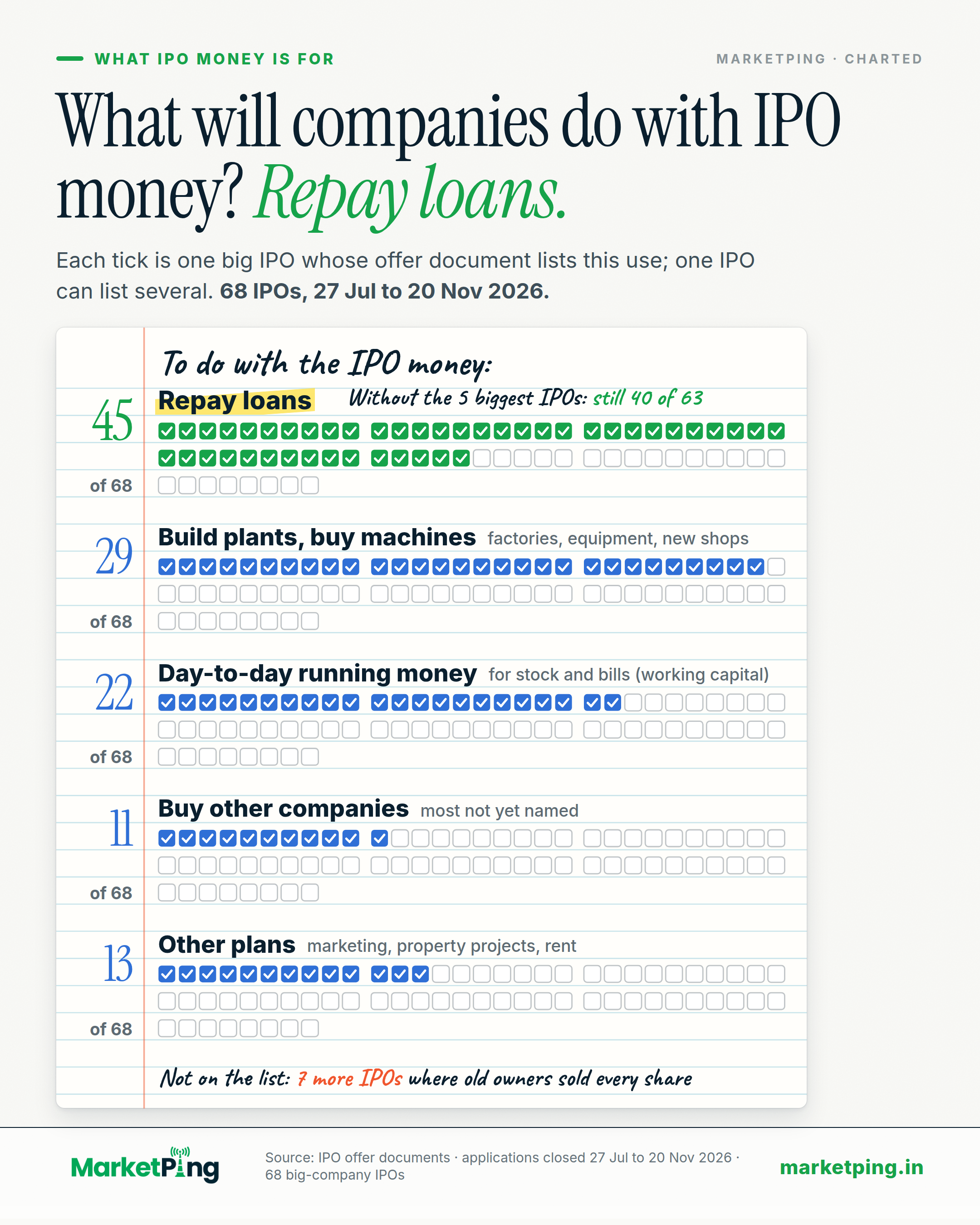
Each tick is one big IPO whose offer document lists this use; one IPO can list several. 68 IPOs, 27 Jul to 20 Nov 2026.
What the chart shows
Of the 68 big-company IPOs whose applications closed from 27 July to 20 November 2026, 45 said in their offer documents that some of the new money would go to repaying loans. It is the most common use, and it stays on top without the 5 biggest IPOs (40 of 63).
What the 68 offer documents list (one IPO can list several uses)
| Repay loans | 45 of 68 |
|---|---|
| Build plants, buy machines (factories, equipment, new shops) | 29 of 68 |
| Day-to-day running money, to buy stock and pay bills (working capital) | 22 of 68 |
| Buy other companies | 11 of 68 (9 of them name no company yet) |
| Other plans, like marketing, property projects, rent | 13 of 68 |
7 more big IPOs are not on the list: old owners sold every share, so the company got no new money. Small-company (SME) IPOs over the same weeks: of the 67 whose offer documents we read, 48 list building plants or buying machines, 41 day-to-day running money and 32 repaying loans.
What this is: when a company sells new shares in an IPO, its offer document sets out what it plans to do with that money. We counted how many offer documents list each use. What it is not: a record of what was actually spent later, and not a verdict on any IPO. Repaying loans is not good or bad by itself.
How it is measured
When a company sells new shares in an IPO, its offer document sets out what it plans to spend that money on (the "objects of the issue"). We read that list for every big-company (main-board) IPO whose applications closed from 27 July to 20 November 2026, and counted how many list each use. One IPO can list several uses, so the counts add up to more than 68.
How each line is sorted: "repay loans" = repaying or paying early any borrowing, loan or debt (including loans taken for day-to-day running); "build plants, buy machines" = spending on things a business keeps for years: plants, factories, machines, equipment, computers, new shops and their fittings; "day-to-day running money" = working capital, the money a business needs to buy stock and pay bills; "buy other companies" = buying companies or a bigger stake in one, named or not yet named (buying land or property projects is not counted here); "other plans" = everything else the lines name: marketing (4), property projects (3), rent (3), technology (3), its own funds (1), bank guarantees (1), money to lend (1), research (1), companies it owns (1). Money a company puts into a company it owns is counted under what that money is for: if it pays back that company's loans, it counts as repaying loans. Not counted: "general corporate purposes" (money the company decides how to use later) and the costs of the IPO itself, because not every offer document gives them a line of their own.
Left out: 7 IPOs where existing owners sold every share, so the company got no new money and had no list, and 1 whose offer document we have not read for this. Checked without the 5 biggest IPOs: repaying loans is still the most common use, 40 of 63. This is what offer documents say the money is for, before the IPO. It is not a record of how the money was spent later, and no use is good or bad by itself.
How this chart has read
The finding in one sentence, on each day its numbers changed.
- Of the 68 big-company IPOs whose applications closed from 27 July to 20 November 2026, 45 said in their offer documents that some of the new money would go to repaying loans. It is the most common use, and it stays on top without the 5 biggest IPOs (40 of 63).
- Of the 67 big-company IPOs whose applications closed from 27 July to 2 November 2026, 44 said in their offer documents that some of the new money would go to repaying loans. It is the most common use, and it stays on top without the 5 biggest IPOs (39 of 62).
- Of the 66 big-company IPOs whose applications closed from 27 July to 30 October 2026, 43 said in their offer documents that some of the new money would go to repaying loans. It is the most common use, and it stays on top without the 5 biggest IPOs (38 of 61).
- Of the 65 big-company IPOs whose applications closed from 27 July to 29 October 2026, 42 said in their offer documents that some of the new money would go to repaying loans. It is the most common use, and it stays on top without the 5 biggest IPOs (37 of 60).
- Of the 63 big-company IPOs whose applications closed from 27 July to 23 October 2026, 41 said in their offer documents that some of the new money would go to repaying loans. It is the most common use, and it stays on top without the 5 biggest IPOs (36 of 58).
- Of the 61 big-company IPOs whose applications closed from 27 July to 19 October 2026, 39 said in their offer documents that some of the new money would go to repaying loans. It is the most common use, and it stays on top without the 5 biggest IPOs (34 of 56).
- Of the 60 big-company IPOs whose applications closed from 27 July to 16 October 2026, 38 said in their offer documents that some of the new money would go to repaying loans. It is the most common use, and it stays on top without the 5 biggest IPOs (33 of 55).
- Of the 59 big-company IPOs whose applications closed from 27 July to 5 October 2026, 37 said in their offer documents that some of the new money would go to repaying loans. It is the most common use, and it stays on top without the 5 biggest IPOs (32 of 54).
- Of the 57 big-company IPOs whose applications closed from 27 July to 30 September 2026, 36 said in their offer documents that some of the new money would go to repaying loans. It is the most common use, and it stays on top without the 5 biggest IPOs (31 of 52).
Using this chart
Free to quote and republish. This chart, with its text, is licensed under Creative Commons Attribution 4.0, including for commercial use and news reporting.
- Reprint the chart, or redraw it in your own style
- Quote its finding and figures
- Use it in print, online, on screen or on air
- Credit MarketPing
- Link to this page where your format allows
- Give the data date: 22 November 2026
The licence covers this page only, not the rest of MarketPing or its data. See our Terms, section 9A.
How to cite
- News storyIn print or online copy
Source: MarketPing, data as of 22 Nov 2026 (marketping.in/charts/ipo-uses) - Chart or broadcastUnder the chart, on screen or on air
Source: MarketPing (marketping.in) - Research paperAPA style
MarketPing. (2026, November 21). What will companies do with IPO money? Repay loans. [Chart]. https://marketping.in/charts/ipo-uses
Keep the date: this chart is rebuilt every day and may read differently tomorrow.
More on ipos


Facts from public exchange data and company filings. Not investment advice, and not a recommendation about any security. For frozen, citable findings with a full method, see our studies.