
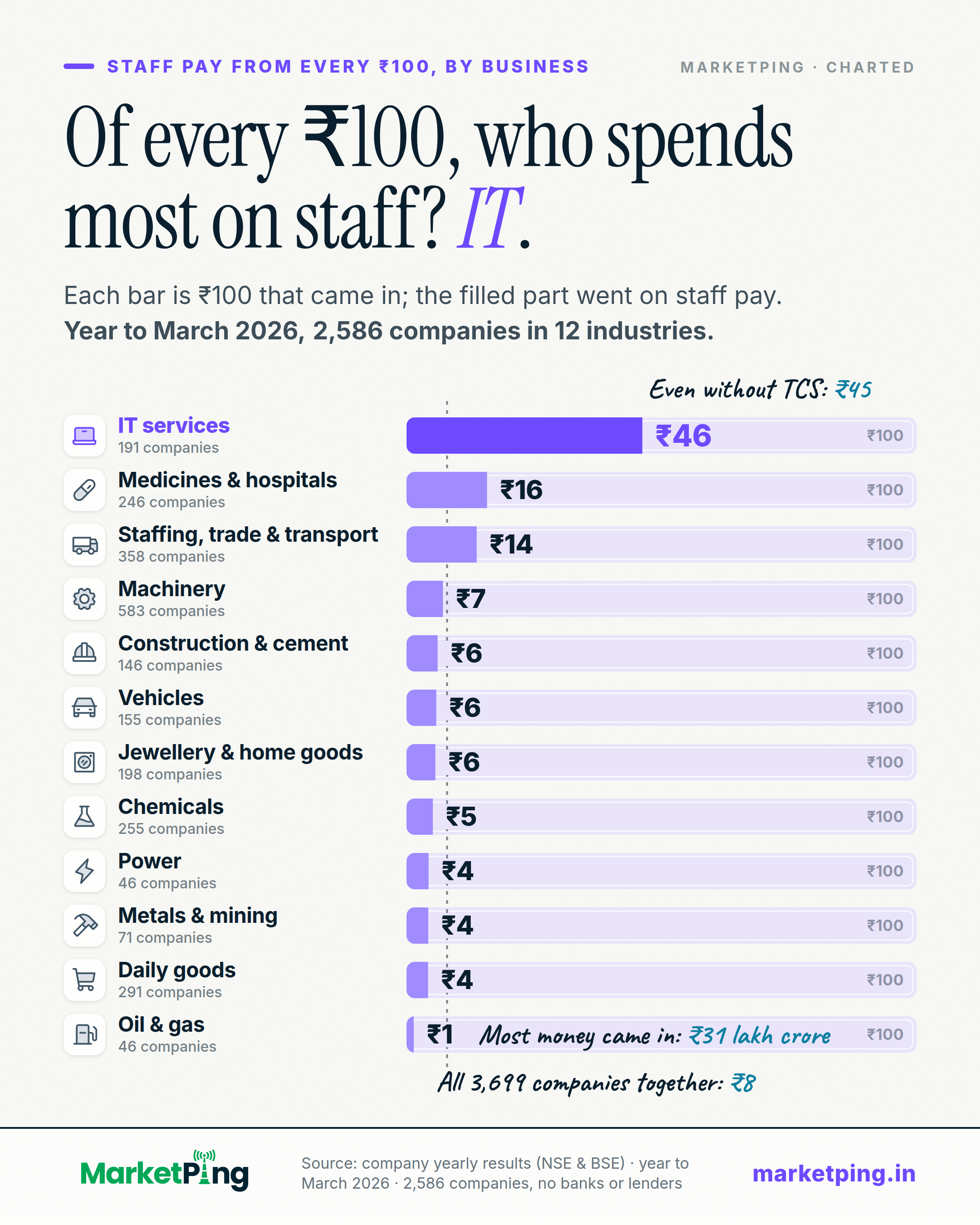
Of every ₹100, who spends most on staff? IT.
Each bar is ₹100 that came in; the filled part went on staff pay. Year to March 2026, 2,586 companies in 12 industries.
What the chart shows
In the year to March 2026, IT companies spent ₹46 of every ₹100 they took in on staff pay, the most of any industry. Oil and gas companies spent ₹1. All 3,699 companies added together: ₹8.
Staff pay from every ₹100 that came in, by industry
| IT services | ₹46 (191 companies) |
|---|---|
| Medicines & hospitals | ₹16 (246 companies) |
| Staffing, trade & transport | ₹14 (358 companies) |
| Machinery | ₹7 (583 companies) |
| Construction & cement | ₹6 (146 companies) |
| Vehicles | ₹6 (155 companies) |
| Jewellery & home goods | ₹6 (198 companies) |
| Chemicals | ₹5 (255 companies) |
| Power | ₹4 (46 companies, 12 of them water and waste) |
| Metals & mining | ₹4 (71 companies) |
| Daily goods | ₹4 (291 companies) |
| Oil & gas | ₹1 (46 companies) |
Smaller industries, not drawn: Media ₹14 (78 companies), Shops & hotels ₹12 (157 companies), Clothes & textiles ₹10 (257 companies), Paper ₹8 (49 companies), Property ₹7 (149 companies). Left out: mixed businesses (13 companies) and telecom (29 companies), too few companies or one company too big to add up fairly. Is it just one big company? No: leave out TCS and IT companies still spent ₹45. Why oil and gas is so low: ₹69 of every ₹100 those companies took in went on raw materials and goods bought to resell, for refiners mostly crude oil. Staffing, trade & transport: more than half of its staff pay (58%) is at 88 staffing and office-service firms such as Quess and TeamLease, whose people work at other companies.
What this is: each company's own yearly accounts, all the companies in an industry added together. Staff pay is salaries, bonuses and benefits such as provident fund, as the accounts report them. Banks and lenders are left out. Big companies weigh more than small ones. What it is not: what any one employee earns, or a sign that an industry is good or bad.
How it is measured
Staff pay from every ₹100 that came in, industry by industry, for the year to March 2026, from each company's own yearly accounts: the company alone, not its group (standalone), so a listed company owned by another listed company is not counted twice. The definitions are the same as on our "where every ₹100 goes" poster, where all companies together spent ₹8 of every ₹100 on staff: the ₹100 is everything a company took in (sales plus other income such as interest received); staff pay is the accounts' employee cost line (employee benefits expense): salaries and wages, bonuses, provident fund and gratuity, staff welfare and shares given to staff. It is not what any one employee earns; workers hired through contractors are usually paid under other expenses, so most of their pay is not in it.An industry's figure is all its companies' staff pay added together divided by all their income added together, so big companies weigh more than small ones. 3,699 companies pass (the same 3,699 as the ₹8 figure): left out are 720 banks, lenders, insurers and other financial companies, 79 with no income, 833 with a line missing from their filing.
Industry is the industry group on file for each company, in plain words; Power includes water and waste companies, Construction & cement joins builders and cement makers, Jewellery & home goods is jewellery, paint, appliances and other things for the home, and Staffing, trade & transport is traders, staffing and office-service firms, airlines, logistics and shipping. 381 of the 3,699 companies have no industry on file and are in no row (together they spent ₹6.7 of every ₹100 on staff); they are in the all-company ₹8. An industry is drawn only with at least 40 companies and no one company above 40% of its income, else the row would be one company's result. Left out on that rule: Mixed businesses (13 companies; DCM Shriram is 47% of its money), Telecom (29 companies; Airtel is 51% of its money).
The chart shows the top industry and then the biggest industries by money taken in, 12 in all (91% of all the income); the smaller ones are in the post text. The top industry is named in the headline only because it stays above every other industry even with each industry's biggest company left out (IT services without TCS: ₹45). Staffing, trade & transport: more than half of its staff pay (58%) is at 88 staffing and office-service firms such as Quess and TeamLease, whose people work at other companies.
Bars are drawn from the exact figure; the printed rupees are rounded to whole rupees. This is arithmetic on filed accounts, not a view on any company or industry.
Using this chart
Free to quote and republish. This chart, with its text, is licensed under Creative Commons Attribution 4.0, including for commercial use and news reporting.
- Reprint the chart, or redraw it in your own style
- Quote its finding and figures
- Use it in print, online, on screen or on air
- Credit MarketPing
- Link to this page where your format allows
- Give the data date: 8 October 2026
The licence covers this page only, not the rest of MarketPing or its data. See our Terms, section 9A.
How to cite
- News storyIn print or online copy
Source: MarketPing, data as of 8 Oct 2026 (marketping.in/charts/staff-share) - Chart or broadcastUnder the chart, on screen or on air
Source: MarketPing (marketping.in) - Research paperAPA style
MarketPing. (2026, October 7). Of every ₹100, who spends most on staff? IT. [Chart]. https://marketping.in/charts/staff-share
Keep the date: this chart is rebuilt every day and may read differently tomorrow.
More on more charts



Facts from public exchange data and company filings. Not investment advice, and not a recommendation about any security. For frozen, citable findings with a full method, see our studies.