
Companies keep ₹9 of every ₹100 as profit
Each coin is ₹1 of every ₹100 that came in. 3,699 companies added together, year to March 2026.
What the chart shows
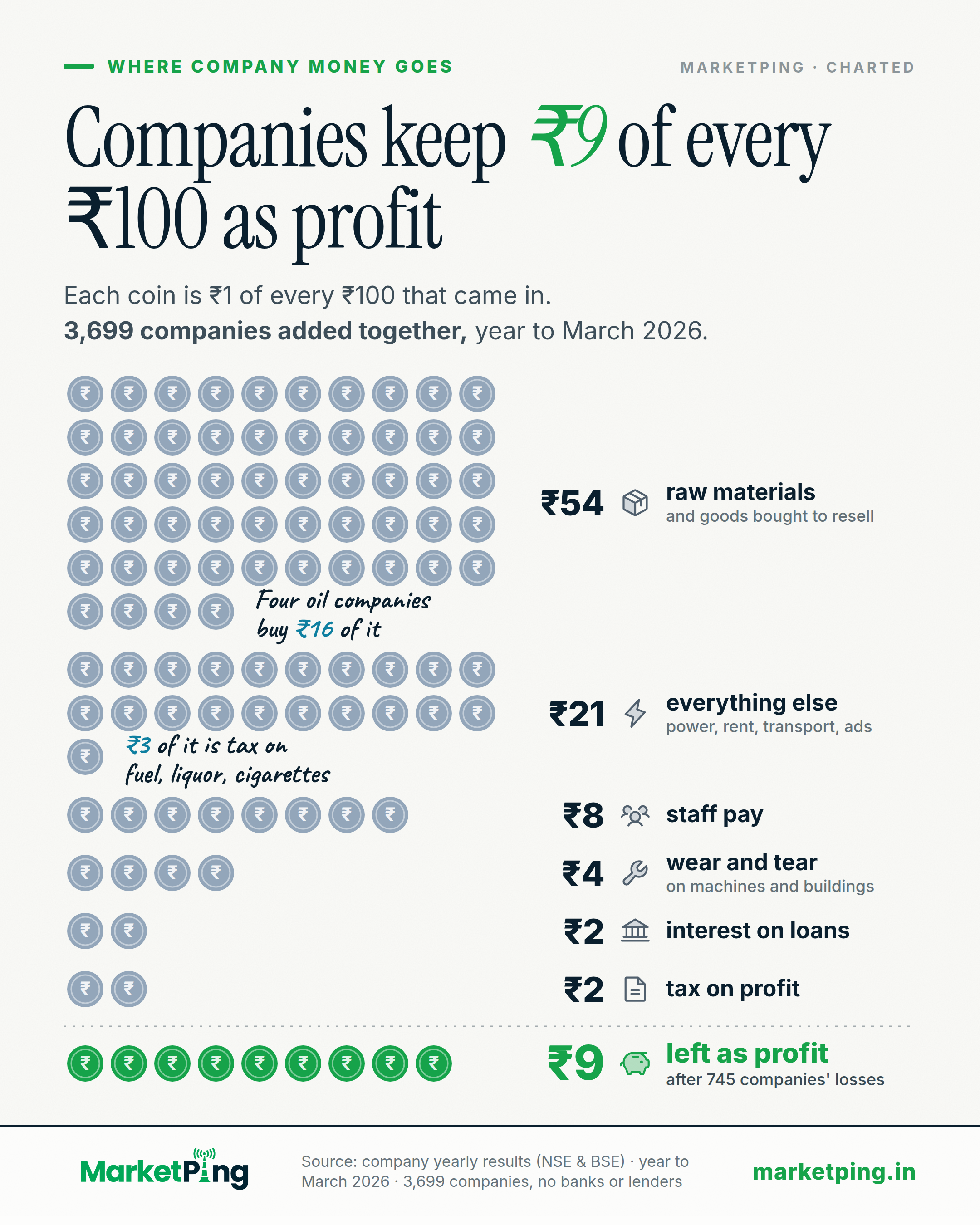
Of every ₹100 that India's listed companies (leaving out banks and lenders) took in during the year to March 2026, ₹9 was left as profit after every cost and tax.
Where every ₹100 went (3,699 companies added together)
- ₹54 raw materials and goods bought to resell
- ₹21 everything else: power, rent, transport, ads, repairs (₹3 of it is excise tax on fuel, liquor and cigarettes)
- ₹8 staff pay
- ₹4 wear and tear on machines and buildings
- ₹2 interest on loans
- ₹2 tax on profit
- ₹9 profit, what is left (after 745 companies' losses)
Together they took in ₹111.3 lakh crore and kept ₹9.9 lakh crore as profit. 745 of them made a loss, and their losses are taken off.
What this is: each company's own yearly accounts, for companies that are not banks, lenders or insurers, all added together. The ₹100 is their sales plus other income, such as interest earned. Big companies weigh more: Indian Oil alone brought in ₹8 of every ₹100. What it is not: one company's split, or cash in the bank. One-off gains and costs, such as a gain from selling or splitting off a business, are left out.
How it is measured
Where the money went, for 3,699 listed companies added together, from each company's own yearly accounts for the year to March 2026: the company alone, not its group (standalone), so a listed company owned by another listed company is not counted twice. The ₹100 is everything they took in: sales (₹108.1 lakh crore) plus other income such as interest and dividends received (₹3.2 lakh crore), ₹111.3 lakh crore in all. Raw materials and goods bought to resell is everything the accounts spend on materials, on goods bought to sell on and on the change in stock (total costs less staff, interest, wear and tear and other costs); everything else is the accounts' "other expenses" line; wear and tear on machines and buildings is the depreciation line; tax is the tax on profit charged for the year, including tax set aside for later years (current and deferred tax); profit is what is left after all of it.
Big companies weigh more than small ones: Indian Oil alone brought in ₹8.0 of every ₹100, and the ten biggest ₹31.5. Losses count: 745 companies spent more than they took in, ₹48,111 crore in all, and that comes off the profit. One-off items are kept out of the ₹100: one-off gains and costs such as selling a stake or a one-time charge (exceptional items; 482 companies, a net ₹65,449 crore gain), and gains or losses booked after tax such as splitting off a business (68 companies, a net ₹90,869 crore gain).
With them, profit as the companies reported it was ₹10.3 per ₹100. Everything else includes ₹3.0 of excise duty that 37 companies, mostly fuel, liquor and cigarette makers, itemise in their filings. A dividend one listed company pays another is counted in both.
Left out: 720 banks, lenders, insurers and other financial companies (their raw material is money, and interest is their main cost), 79 companies with no income for the year, 833 with a line missing from their filing (829 of them the wear-and-tear line; 780 report results only twice a year or less; ₹1.4 lakh crore of income between them). The pieces are rounded to whole rupees so they add to exactly ₹100 (largest-remainder rounding). This is arithmetic on filed accounts, not a view on any company.
Using this chart
Free to quote and republish. This chart, with its text, is licensed under Creative Commons Attribution 4.0, including for commercial use and news reporting.
- Reprint the chart, or redraw it in your own style
- Quote its finding and figures
- Use it in print, online, on screen or on air
- Credit MarketPing
- Link to this page where your format allows
- Give the data date: 8 October 2026
The licence covers this page only, not the rest of MarketPing or its data. See our Terms, section 9A.
How to cite
- News storyIn print or online copy
Source: MarketPing, data as of 8 Oct 2026 (marketping.in/charts/rupee-split) - Chart or broadcastUnder the chart, on screen or on air
Source: MarketPing (marketping.in) - Research paperAPA style
MarketPing. (2026, October 7). Companies keep ₹9 of every ₹100 as profit [Chart]. https://marketping.in/charts/rupee-split
Keep the date: this chart is rebuilt every day and may read differently tomorrow.
More on profits, tax and dividends


Facts from public exchange data and company filings. Not investment advice, and not a recommendation about any security. For frozen, citable findings with a full method, see our studies.